
What components are included in a fuel pump assembly?
Jan 15, 2026
For heavy equipment owners and fleet managers, understanding the machine's fuel system is key to avoiding costly downtime. The fuel injection pump assembly is a precision core component of a diesel engine, responsible for delivering fuel at precise times and pressures. Although it is often viewed as a single component, it is actually a complex assembly composed of interconnected components. This guide will detail its internal structure, working principle, and maintenance precautions, and will highlight reliable alternatives, such as the 463-1678 fuel injection pump assembly for Caterpillar C7.1 engines.
1. Fuel Pump Assembly Diagram
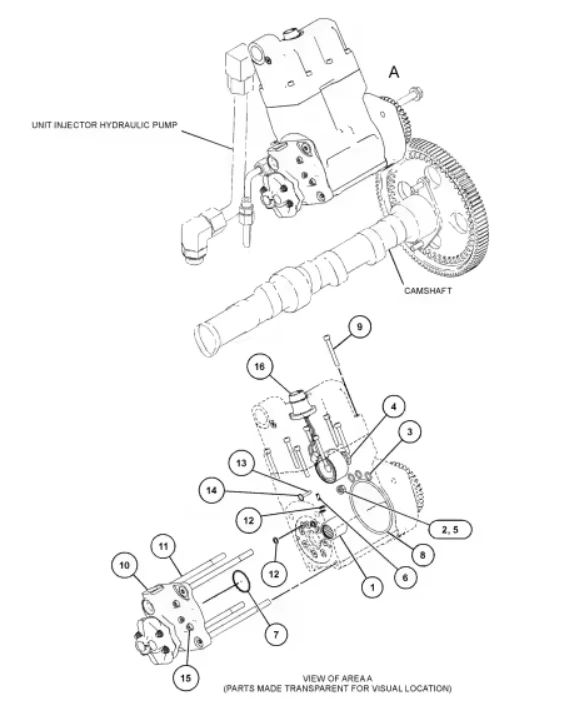
The fuel injection pump assembly can be considered a precision high-pressure metering device. It is more than just a pump; it is a system designed to achieve high precision. Here are the components you'll typically find within it:
Housing/Casing: A robust metal casing that houses all the internal parts, designed to withstand high pressure and engine vibrations.
High-pressure pump components: core components that generate the extremely high pressures required by modern common rail systems. This includes the plunger and cylinder used to pressurize the fuel.
Camshaft or rotor: The drive mechanism that produces the pumping action. In many designs, such as the 463-1678 assembly, the camshaft drives the plunger.
Fuel metering and control system: This includes a fuel metering valve (usually a solenoid valve) that precisely regulates the amount of fuel entering the high-pressure side according to instructions from the engine control unit (ECU).
Pressure relief valves and regulating valves: critical safety and performance components used to maintain stable common rail pressure and prevent overpressure.
Driveshaft and Seals: The driveshaft connects to the engine to provide rotational power, while high-quality seals prevent internal and external fuel leaks.
Fuel inlet and outlet: The inlet for low-pressure fuel entering from the fuel pump, and the outlet for high-pressure fuel being delivered to the common rail.
High-quality assemblies, such as 463-1678 which meets OEM specifications, ensure that all these components are manufactured to precise tolerances, enabling seamless operation in the Caterpillar C7.1 engine's fuel system.
2. Main Components of Truck Fuel Pump Assemblies (In-Tank and External Types)
It is crucial to distinguish between the two main fuel pump mounting locations, as their "assembly" structures differ:
In-Tank Fuel Pump Assembly (common in modern trucks and vehicles):
This is typically an electric fuel delivery module. Its main function is to provide the engine with a stable pressurized fuel. This assembly includes:
Electric fuel pump.
Fuel level sensor (float and sensor).
Strainer or "filter element" filter.
Internal fuel lines and housing bracket.
Mounting flange and electrical connector.
External/engine-driven fuel injection pump assembly (common in heavy-duty diesel equipment):
This is a high-pressure pump, typically mechanically driven by the engine (e.g., 463-1678). It is mounted on the engine block, and the focus of its assembly is to generate injection pressure. It includes the components listed in Section 1, but does not include the tank-integrated level sensor or filter cartridge. For systems like the CAT C7.1 common rail system, this pump is responsible for supplying ultra-high pressure fuel to the common rail line that supplies fuel to the injectors.
3. Is it just the fuel pump? What components are actually included in a complete fuel pump module kit?
For an engine-driven fuel injection pump like the 463-1678, a complete kit should include:
• A fully assembled pump unit: This is the core component-a housing containing all internal components (plungers, camshaft, valves), all pre-installed and, most importantly, pre-calibrated.
• Key installation hardware: New seals, gaskets, O-rings, and usually also the necessary mounting flanges to ensure no leaks after installation.
• Drive coupling or gear: The component that connects the pump drive shaft to the engine gear system.
• (Sometimes) Integrated control solenoid valve: usually an electronic fuel metering valve that is part of a modern pump assembly.
Purchasing complete pre-assembled units from trusted suppliers like Onode Truck Parts ensures compatibility and saves significant labor time compared to rebuilding an old pump using individual internal parts.
4. How to Diagnose Fuel Pump Failures and Failures of Other Components (Fuel Sensor, Fuel Filter)
Accurate diagnosis can prevent unnecessary replacements. Here are the symptoms of a malfunctioning fuel injection pump assembly (e.g., 463-1678):
Difficulty or inability to start: Insufficient fuel pressure to generate enough fuel for ignition.
Engine power and performance decline: The fuel pump is unable to provide the required amount or pressure of fuel under load.
Engine misfire or unstable operation: Irregular pressure delivery leads to uneven combustion.
Increased fuel consumption and black smoke: Insufficient pressure and metering lead to incomplete combustion.
Abnormal noise from the fuel pump area: The fuel pump itself may emit a whistling, knocking, or ticking sound.
How to verify:
Check for Diagnostic Trouble Codes (DTCs): Use a diagnostic scanner. Codes related to low fuel rail pressure or metering valve control typically point to the injection pump.
Perform a fuel pressure test: Connect the high pressure gauge to the test port on the common rail. Compare the readings at idle and under load with the manufacturer's specifications. A persistently low pressure indicates a fuel pump malfunction.
Visual inspection: Check the fuel pump housing, seals, or connections for external fuel leaks.
Important note: Symptoms such as unstable fuel gauge readings are related to the fuel sensor inside the fuel tank, not the injection pump. Power loss can also be caused by a clogged main or auxiliary fuel filter, so these filters should always be checked and replaced first.
5. Four Key Things to Check When Purchasing a Fuel Pump Assembly Kit
Accurate OEM Part Number and Compatibility: This is crucial. Verify that the part number matches your engine model exactly. For example, the 463-1678 / 4631678 assembly is specifically calibrated for the Caterpillar C7.1 engine, which is used in excavators such as the 320D2, 323D3 and 329D2.
Cross-reference other part numbers, such as 20R-4819 or 398-1498, for confirmation. Manufacturing quality and materials: The fuel pump must be able to withstand extremely high pressures and contaminated fuel. Choose assemblies made of high-speed steel (HSS) or forged alloy steel components, as these materials offer the durability and wear resistance required for heavy-duty applications.
Package completeness: Ensure it is a complete module. Does it include all the gaskets, seals, and hardware required for installation? A complete kit prevents delays and ensures a good seal from the moment the box is opened.
Supplier warranty and support: Reliable suppliers will provide guarantees for their products. Look for clear warranties (e.g., 6-12 months) and convenient technical support. This can protect your investment and provide assurance for critical repairs.
Conclusion
The fuel injection pump assembly is a precision-engineered system, not a simple component. Understanding its components, how to diagnose faults, and how to select high-quality replacement parts are key skills for maintaining optimal equipment performance. When diagnostic results indicate a fuel pump failure, selecting an original equipment manufacturer (OEM) assembly, such as the 463-1678 fuel injection pump for Caterpillar engines, ensures reliable, efficient, and long-lasting repairs.
CONTACT
location:
No. 9,Sanqiao Road, Fengdong New City, Xi'xian New District, Xi'an , Shaanxi,China
Moblie/whatsapp/wechat:
+86 13310989421
Email:
laifeng@onodetruckparts.com